
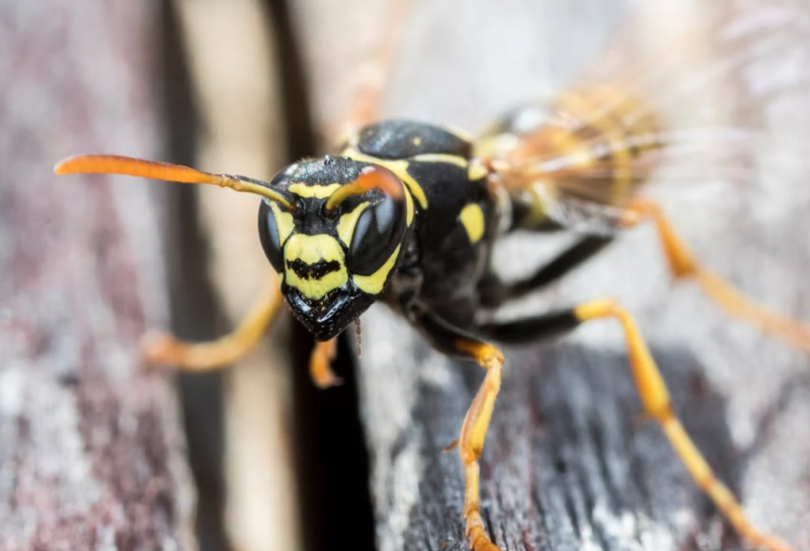
The Eastern hornet, also known as the oriental wasp, is not particularly popular, to put it mildly. It preys on honeybees, appears at picnic tables, and its sting is quite painful.
But did you know that without this wasp, the global wine industry would look completely different?
A conversation with a researcher who studies the exceptional traits of Eastern hornets revealed a range of surprising characteristics, from their extreme tolerance to alcohol to their highly complex social system.
What makes the Eastern hornet so special?
The Eastern hornet is unique in its ability to survive under extreme desert conditions.
It is found across a wide range of environments, from mountainous regions at high elevations down to arid southern areas.
Another interesting fact is that this is a social wasp with the highest level of social organization among insects, known as eusociality.
Eusociality evolved several times during insect evolution, such as in bees, ants, and termites, and is defined by three classic criteria.
The first criterion is reproductive division of labor.
There is a caste that is sterile, the workers, which do not reproduce.
In contrast, there is a reproductive caste consisting of queens and males.
In Eastern hornets, there is only one queen.
Second, the nest contains overlapping generations.
Generations of offspring such as the queen, her young worker daughters, and sometimes an additional generation of workers live together at the same time and share the same nest. Finally, there is cooperative care of offspring.
Care for the next generation is not provided only by the mother.
Workers feed, clean, and protect the larvae.
This complex system forms the foundation of the hornets’ intricate social structure.
What led to studying the Eastern hornet in particular?
What first captured interest was its diet.
Adult hornets are remarkably efficient hunters.
They hunt insects with great effectiveness. Honeybees are a particular favorite, and the hornets cut off their heads and abdomens, taking only the flight muscles.
This is the reason they are so hated by beekeepers.
In addition to live prey, hornets also collect meat from carcasses.
They are capable of carrying enormous weights over long distances.
However, despite specializing in protein collection, they are very poor at breaking it down. Here lies the surprising social and nutritional secret.
The protein they collect is brought back to the nest and fed to their younger sisters, which are still in the larval stage. Hornet larvae are plump, pale, and immobile.
They receive the meat from their adult sisters, digest it, and convert the protein into sugars and free amino acids.
These sugars, in a drop of sweet bitter liquid, are then given back to the adult sisters.
This liquid likely also affects colony function.
Research has shown that these unusual relationships, in which adults depend on younger stages, are what sustain the hornets’ complex social structure.
It is an almost poetic example of adults feeding on the sweetness of the young.
What roles does the Eastern hornet play in the ecosystem?
Hornets regulate insect populations, remove carcasses, and pollinate many flowers.
But they also have one very important role that few people know about.
They store and spread yeasts, especially baker’s yeast, which is essential for both baking and alcohol production and fermentation. In fact, without hornets, very few yeasts would reach wine grapes in autumn, and it would be impossible to make wine without artificially adding yeast to the fermentation mixture.
Hornets carry an enormous number of wine yeast strains and have a significant influence on the character of wine.
As a creature that lives in partnership with yeast, Eastern hornets were found to have exceptional resistance to alcohol.
In one study, hornets were raised on 80 percent alcohol as their sole energy source.
Despite this, no effect was found on their lifespan or behavior.
This was the most surprising discovery.
Genes were identified in the hornet genome that may explain this adaptation, and this is currently under investigation.
The implications are substantial for understanding and addressing alcoholism, a problem responsible for about five percent of deaths worldwide.
It appears that hornets have considerable influence on humans.
How does human activity affect them?
Hornets are closely connected to human activity.
They are attracted to honeybees raised by humans and to human food.
There is also a hypothesis that the domestication of yeast and the wine industry have influenced hornets, a topic currently under research.
In terms of threats, there is no significant threat posed by humans to the Eastern hornet, even though some people attempt to exterminate them.
With climate change and the warming of regions that were previously unsuitable for them, the Eastern hornet is actually expanding its range.
For example, it is spreading across large areas of Europe and has recently been accidentally introduced to both South and North America, where it has begun to spread.
In addition, the Eastern hornet has a remarkable ability to regulate nest temperature.
It can heat the nest when it is cold and cool it when it is hot, maintaining it within a very narrow temperature range.
This ability allows it to cope with changing conditions such as warming climates.
How are hornets studied, and what challenges are involved?
Hornets are very aggressive, and researchers work with special protective equipment.
At the same time, the hornets become accustomed to those who work with them and are able to recognize the caretaking team.
In the laboratory, the colonies are open.
They are housed in a special structure but have an opening to the outside and can come and go freely.
Nests that were designated for extermination are rescued, brought to the laboratory, and given safe and comfortable conditions.
Without the research, they would have been destroyed.
Recently, work has also begun on an additional project.
Another species of social wasp exists alongside the Eastern hornet.
An integration was created between the two species, initially as a joke, but mixed colonies were formed in which the workers coordinated perfectly.
This unusual system is used to study effects on physiological measures, behavior, and the microbiome of hornets.
It is surprising to discover so much about an animal that can be somewhat intimidating to encounter in nature or on the side of a building.
Is there any advice for the brave?
Humans fear hornets, and somewhat justifiably, as their sting is very painful and can be dangerous. However, they do not tend to attack and usually sting only in self defense.
In any case, it is best to admire them from a safe distance.