
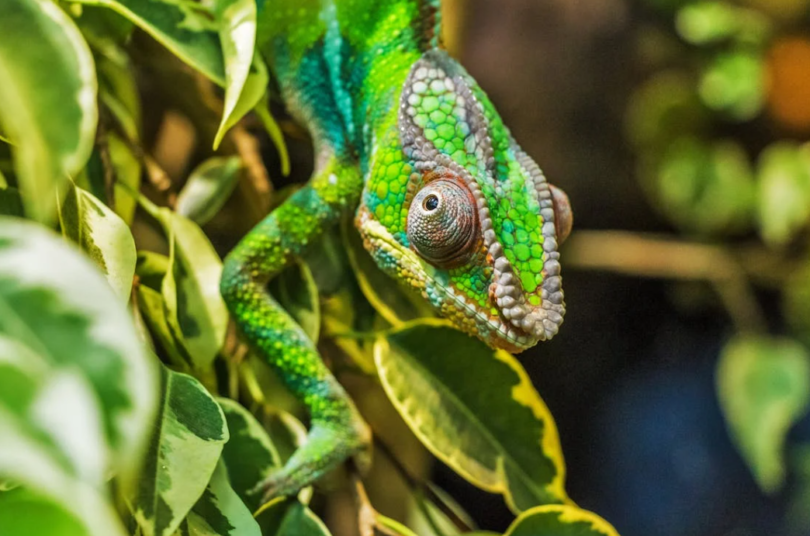
Behind the color changes of chameleons lies a surprisingly complex social life and unexpected behaviors.
A conversation with a long time researcher who has studied the behavior of Mediterranean chameleons in their natural environment for over two decades revealed a world of deception, cannibalism, beauty, and sophistication.
Over the years, chameleons are occasionally spotted on tree branches in gardens. Where can chameleons actually be found?
The Mediterranean chameleon is found across a wide range of regions, from arid southern areas northward to mountainous zones.
It lives in diverse habitats such as woodland areas, river environments, and sandy landscapes.
Its global distribution is quite broad, ranging from North Africa through the Arabian Peninsula to islands in the Mediterranean Sea and coastal regions in southern Europe.
It is known that chameleons live on plants, but the unique complexity of their daily movement patterns within the three dimensional space of vegetation is less familiar.
In a controlled study, daily movement patterns were examined on woodland plants.
During summer, chameleons prefer to position themselves for sleep on the eastern or southern side of the plant, roughly at mid height.
Often they sleep at the edge of a branch, which may prevent predation by tree climbing snakes.
During daylight hours, they are exposed at the branch edge to other predators such as birds of prey, and indeed they move toward the center of the plant at first light.
Sleeping on the side where the sun rises may help them retreat into the plant as early as possible. Only after several hours do they move out to the outer branches.
They then change position every few minutes and gradually climb higher until during the hottest midday hours they are located at the top or upper two thirds of the plant.
Regarding conservation status, the Mediterranean chameleon is currently not considered at risk, partly because it adapts well to living in environments that are no longer natural, including public gardens and residential areas.
However, it is harmed by habitat destruction due to development, construction, and agriculture, as well as by non native species such as domestic cats and invasive birds.
In contrast, another subspecies that inhabits sandy desert regions is classified as critically endangered.
Its range continues to shrink due to development, infrastructure expansion, and agricultural spread. From a climate perspective, this chameleon is particularly sensitive to rising temperatures because its eggs are laid in nests dug into the ground.
Excessive heat may damage the eggs, reducing the survival chances of the embryos.
Although the Mediterranean chameleon is not endangered, all chameleons are protected by law, and it is forbidden to harm or collect them.
At present, there are no specific conservation programs dedicated to their protection, so the primary responsibility lies with the public to avoid harming them or removing them from the wild.
The most familiar trait of chameleons is their ability to change color.
A comparative study examined chameleons from different regions and species and found that while populations of the same species show differences in characteristic color patterns, the causes of those differences vary between species.
In one case, variation in color patterns resulted from a combination of genetic isolation due to population distance and the presence of multiple male reproductive strategies.
In another species, such variation was not observed.
The findings suggest that color patterns are shaped by different sets of pressures in each species. Interestingly, environmental color defined as ground and vegetation color was found not to influence the characteristic color patterns of populations.
Despite common assumptions about camouflage, adaptation to background color does not appear to be an evolutionary factor shaping chameleon coloration.
If camouflage is not the reason for color change, what is?
The answer lies in communication.
Chameleons communicate with each other through changes in body color and color patterns.
Their bodies function like billboards that rapidly switch between more than ten different color patterns, appearing in various contexts, both social and related to adjustment within their environment. This ability exists in only a few animal groups, such as cuttlefish.
In addition to color based communication, the diversity of reproductive strategies and their expression in male social status is a unique and fascinating phenomenon.
Males are divided into three social and reproductive categories. In their first breeding season, all males adopt a subordinate strategy.
From the second year onward, some remain larger subordinate males, while others become dominant males that guard females and fight rival males.
Color communication plays a role here as well. Each male type has distinctive color patterns. Young subordinate males turn brown during their first breeding season and resemble females, many of whom also become brown during this period.
Some even develop orange spots, effectively disguising themselves as females.
There have been cases in which dominant males attempted to mate with subordinate males, demonstrating how convincing the disguise can be.
This allows subordinate males to avoid attacks from dominant males and sneak closer to females while dominant males are distracted by other rivals.
One of the most surprising findings in chameleon research involves cannibalism. Controlled observations compared adult chameleons and newly hatched juveniles.
When placed together, the juvenile immediately turned black, hid behind a branch, or dropped to the ground to escape.
This reaction became clear after a cannibalistic event was observed.
A large chameleon chased a juvenile, caught it easily, and immediately shot its tongue and swallowed it.
Following this incident, a controlled experiment using a one way mirror was conducted.
The juvenile could not see the adult and behaved naturally, while the adult could clearly see the juvenile.
One third of the adults attempted to shoot their tongues toward the juvenile behind the mirror, confirming that cannibalism exists in Mediterranean chameleons.
Current research focuses on the relationship between Mediterranean chameleons and life in coastal sand regions, aiming to understand how they use space and whether social structure is reflected in spatial distribution.
Research also continues into the factors influencing color pattern differences between populations, as there are many chameleon species worldwide and still limited information, leaving much more to discover.