
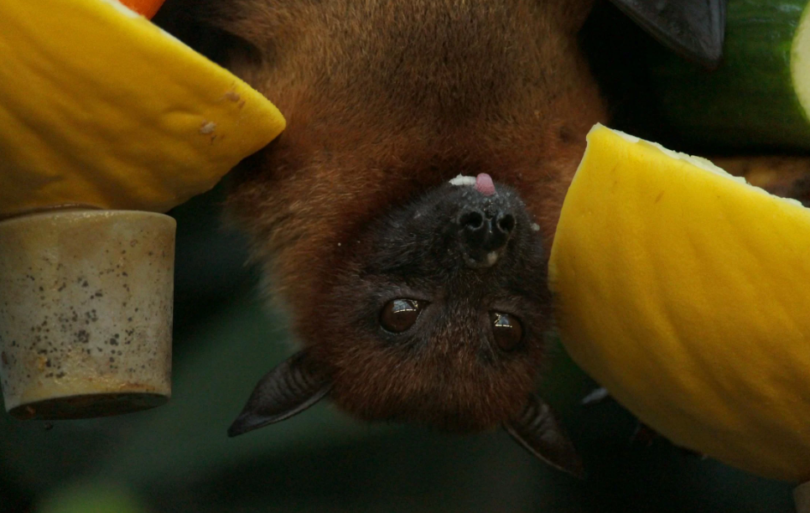
Some people see fruit bats as a nuisance, but they are fascinating animals with impressive cognitive abilities and spatial memory that would rival any navigation app. The distribution of the Egyptian fruit bat stretches from southern Turkey in the north to southern Africa in the south, and eastward to India. It is the most common bat species in the region, and many people have likely encountered it during evening walks beneath rows of fig trees or other fruit trees.
Researchers study this flying mammal in order to understand how fruit bats make decisions and how they combine information based on memory with information obtained from other individuals.
What makes fruit bats unique compared to other animals? Unlike other mammals, bats possess the ability to fly and use sonar, a trait they share with toothed whales. Their physiology is also unique and allows them to live for more than 20 years, which is an exceptionally long lifespan for such a small animal.
Fruit bats can fly up to 100 kilometers to reach fruit bearing trees, although they usually travel distances of 10 to 40 kilometers. They see very well at night, yet they also use a sonar system and are capable of relying on both senses. They have an extraordinary memory of space and time. They remember the locations of dozens of trees at any given moment, as well as the timing of fruit availability. They are highly social and extremely flexible, capable of exploiting any new food source that appears in their environment.
What role do bats play in the ecosystem? Fruit bats pollinate certain tree species, including important agricultural species in East Asia such as durian. They are also highly effective seed dispersers due to the long distances they travel. When a fig tree suddenly begins to grow on a balcony, it is often the result of a fruit bat.
Insect eating bats are important natural pest controllers. A study published in Science recently linked the death of insect eating bats in North America due to a fungal disease with an increase of approximately 30 percent in agricultural pesticide use. According to the study, a rise of about 7 percent in infant mortality was observed in the same areas where pesticide use increased. This requires further research but is nevertheless deeply concerning.
How has human activity changed the lifestyle of fruit bats? Fruit bats appear to prefer urban environments and know how to take advantage of them. This includes an abundant food supply throughout the year, warmer temperatures, and many roosting sites such as underground parking structures. Studies comparing urban and rural fruit bats have found that urban bats are more exploratory and tend to visit more trees each night than their rural counterparts.
How might the climate crisis affect fruit bats? Fruit bats are not expected to be severely affected, but many other bat species likely will be. Most bats feed on insects, and several studies in recent years suggest that global environmental changes are causing severe declines in insect populations, which are their primary food source.
What are the greatest threats facing fruit bats today? In other parts of the world, fruit bats suffer greatly from farmers who unjustly blame them for damage to fruit crops. In contrast, fruit bats in this region face fewer threats, mainly predators such as snakes, birds of prey, and domestic cats. Other bat species face numerous dangers, most of them resulting from human activity. Habitat destruction and the loss of roosting sites are likely the primary threats. Another lesser known risk factor is wind turbines, which kill many bats worldwide. This presents a classic green versus green dilemma, renewable energy versus biodiversity.
Because fruit bats are widespread, there are currently no special conservation efforts dedicated to them in this region. However, they have recently been declared a protected species, and guidelines have been issued for the safe removal of bats from buildings prior to demolition. This procedure is critically important, as many fruit bats roost in structures slated for destruction and have been severely harmed in the past.
How is fruit bat research conducted? Research takes place both in the field and in the laboratory. Whenever possible, researchers prefer working in the field while the animals are free, but certain controlled questions require laboratory conditions. In addition, a special bat colony exists in which bats are free to leave and return, creating a hybrid between field and laboratory research.
One particularly interesting discovery is that fruit bat mothers teach their young how to navigate. When the pups are small, mothers carry them to trees several kilometers away from the colony. When the pups begin navigating independently, they fly to those exact same trees. It appears that they learn the routes while riding on their mothers. These landmark trees provide an initial anchor point that helps the young bats find their way home.
Recent research has also shown that fruit bats map time. They remember how long each tree produces fruit and how much time has passed since their last visit to each tree, allowing them to plan future foraging trips. This reflects a very high level of cognitive ability.
Many research questions remain open. For example, do bats use information over many years? Do they remember individual animals over long periods? What are the limits of their cognitive abilities? There are also many unanswered questions related to genetics and physiology.
How do they live for so many years, and how does their immune system successfully cope with viruses? Despite their public image, bats are not responsible for COVID, and although they are often blamed for transmitting diseases to humans, this has not been scientifically proven. They possess an exceptional immune system that is currently being studied in many laboratories and likely enables both viral tolerance and long lifespans.