
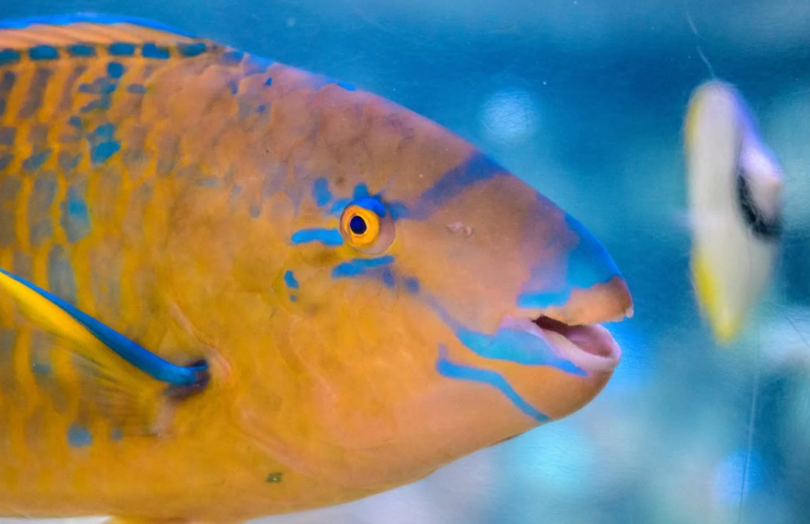
Parrotfish that live in the sea are not just beautiful.
Thanks to them, we have white sand on tropical beaches and colorful coral reefs underwater.
Meet the parrotfish.
Usually, when we think of parrots, we imagine colorful and noisy winged animals. But there are also parrots under water parrotfish.
These fish, named for their large, strong jaw that looks like a beak and their vivid colors, are not only beautiful but serve as diligent maintenance workers and ecological engineers critical to maintaining coral reef health.
Where can we see parrotfish when snorkeling or diving?
The parrotfish group, once considered a separate family and now classified as a tribe within the wrasse family, includes about 90 species living in wide geographic areas the Atlantic Ocean, the Indo-Pacific region, and also the Mediterranean and Red Sea.
Their conservation status varies.
For example, in the Mediterranean we can find species that are not at risk and some invasive species that entered through channels.
In certain areas, there are about 13 species, including an endemic species.
What makes parrotfish so special?
Beyond their beauty and colorfulness, parrotfish play a key role in protecting coral reefs.
Parrotfish are herbivorous.
Hard corals, the reef builders, constantly compete with algae for living space.
Algae grow faster and are less sensitive to changing environmental conditions.
Without parrotfish, algae could easily dominate the corals, potentially collapsing the entire reef ecosystem.
Fortunately, parrotfish help maintain balance.
They act as “maintenance workers,” feeding on algae, especially early when it starts to settle on corals or rocks.
This grazing is vital for coral survival and growth and ensures the reef functions properly.
In addition to grazing and removing algae, parrotfish contribute to bioerosion.
When they nibble on corals and rocks to eat algae,
they grind the material in their mouths and excrete it as sand or sediment elsewhere on the reef.
This process recycles calcium and other elements, with estimates that up to 70 percent of the sand on tropical beaches has passed through the digestive system of parrotfish.
What fascinating behaviors distinguish parrotfish?
Many reef fish, including parrotfish, start life as females and later change to males.
This life cycle, involving sexual maturity first as a female and later as a male, is often accompanied by dramatic changes in color and even physical structure.
Another unique feature is the mucus “sleeping bag” they secrete at night.
The covering, like a large transparent gelatinous sac, envelops their whole body.
Studies show it protects against nocturnal predators by trapping the fish’s scent, or prevents parasites from accessing the fish.
What threats do parrotfish face?
The main threats are overfishing and habitat destruction or loss.
This is especially relevant as coral reefs are constantly at risk.
Climate change threatens many marine organisms, including parrotfish.
Rising water temperatures cause stress and allow pathogens to thrive.
In recent years, massive coral fish die offs, including parrotfish, occurred due to sudden increases in water temperature.
In addition, bleaching events and other reef damage are critical threats to parrotfish.
Studies show that adult male parrotfish inhabit very small areas each individual sleeps and feeds in the same locations for years.
This means that damage to a particular reef area can have a much greater impact on them compared to fish that frequently change their routes and activity.
Conservation efforts for parrotfish focus on protecting habitats, avoiding damage to corals and rocky substrates, and preventing sea pollution.
What drew researchers to study parrotfish?
Interest in the grazing behavior and movement of herbivorous fish and how changes in algae location and availability affect behavior, especially for parrotfish given their critical ecological role.
One surprising discovery about parrotfish?
During research tracking parrotfish with acoustic transmitters (like fitness trackers for fish, allowing monitoring of location and activity), a major storm hit certain reef areas.
Surprisingly, the fish exhibited unusual behavior up to ten days before the storm.
Unlike their normal behavior of reducing activity almost to zero at night, they stopped sleeping at night and showed very high activity during the day.
Previous studies suggested animals respond to extreme weather events up to 48 hours prior.
This finding indicates that parrotfish may sense extreme storms long before they occur, potentially signaling early warnings that we still do not fully understand.
In summary, parrotfish are complex and fascinating fish, essential for coral reef health.
They are not only beautiful and exhibit unique behaviors like sex change and secreting mucus “sleeping bags,” but also have surprising storm-predicting abilities.
Protecting the marine environment, and coral reefs in particular, is key to preserving these finned parrots.