
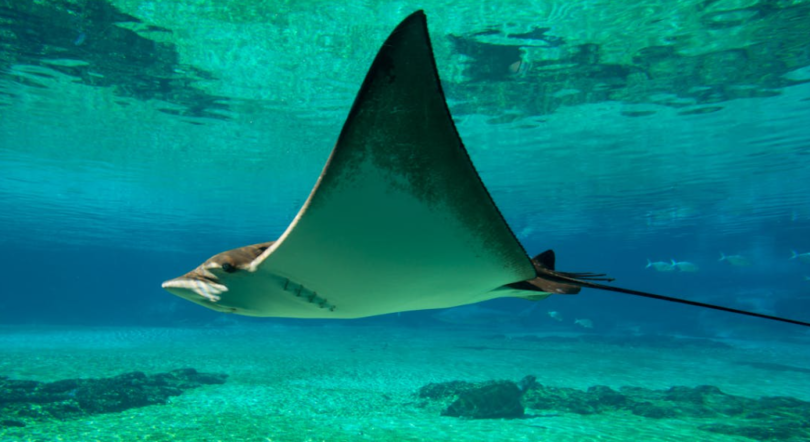
The tails of stingrays sometimes reach several meters in length, as does the tail of their relative, the giant manta ray.
A new study has revealed a previously unknown function of this tail.
Stingrays (Myliobatiformes) are flat cartilaginous fish shaped like a diamond or circle.
The group includes manta rays as well as species from the family Dasyatidae, known as sea cats.
The manta ray is the largest species in the group, with individuals weighing up to two tons and reaching lengths of seven meters, partly due to their tails.
Like manta rays, other stingray species also have long tails. However, until now it was unclear what their purpose is, as they are not used for swimming.
Some species have a venomous barb attached to the tail for defense, while others are non-venomous. Additionally, the barb emerges from the base of the tail and does not require such a long tail.
In a study published earlier this year, researchers from Harvard University discovered that the tail also functions as a sensory organ, allowing certain stingrays to detect subtle water movements, navigate, and avoid danger.
The researchers focused on the species cownose ray (Rhinoptera bonasus).
They collected eight individuals, studied the anatomy of their tails, and found a lateral line system in the tail, previously unknown in stingray tails.
The lateral line system is a sensory system located on the sides of fish and amphibians, allowing them to detect vibrations and movement in water and providing spatial awareness that aids in navigation, orientation, and predator avoidance.
The system consists of canals under the skin and scales, open to the water so that water can enter. Inside the canals are hair cells capable of sensing surrounding movement and sending signals to the nervous system.
Stingrays have a well-developed lateral line system on the sides of their bodies, already known.
Now it has been shown to exist in the tail as well.
The researchers found that the cownose ray tail contains a network of canals serving the lateral line system.
The main canal, the widest, branches into many thinner canals, with small pores at the ends allowing water to enter.
The main canal is wide at the base of the tail and narrows toward the tip, but in the middle of the tail it branches into many fine and complex canals.
Hair cells are present only in the main canal along its length and are connected to the nervous system. Initial research indicated that this system also exists in other stingray species.
The presence of the lateral line system indicates that the tail serves a sensory function, allowing the cownose ray and likely other stingrays, such as manta raysto detect nearby movement, for example, the movement of individuals in a group they swim with or the movement of predators.
Researchers suggest that the more complex and branched the canal system, the more sensitive the tail is, capable of detecting more types of signals and filtering out background noise, comparing water vibrations in terms of intensity.
Thanks to this sensitive tail, stingrays can accurately detect water movements created by living creatures around them, including vibrations caused by prey or predators.